Wednesday, June 25, 2014

Revised view of SRS account

Just expressing my view and not advocating to start SRS. I change my view on SRS after I read this blogger post and I view it from as ‘retirement fund’ perspective. Everyone income level is not same as well as commitment and plan for future, therefore it may not suit him/her. Pls do find out more. Can Google and there are a lot of views from ppl (negative and positive).

This blogger mentioned we can ‘mitigate the so called penalty by slowing taking out’. So, theoretically, if we had $200K or less in our SRS accounts by the time we retire, withdrawals could be non-taxable. Withdrawing the funds in ten equal portions over a period of ten years would lower the income tax payable if we had more than $200K in our SRS accounts by the time we retire.
http://singaporeanstocksinvestor.blogspot.sg/2011/01/srs-brief-analysis.html


  • Our first $20K income is not taxable, therefore if you spread out over 10yrs (Maximum years you can spread), you may not pay any tax for the fund you withdraw from SRS. (SRS scheme states if you withdraw your savings upon retirement, only 50% of the savings withdrawn will be subject to tax. You may also spread your withdrawals over a period of up to 10 years to meet your financial needs. Spreading out your withdrawals will generally result in greater tax savings) http://www.iras.gov.sg/irasHome/page04.aspx?id=282


  • •  Eligibility -> Seem like as long as you pay Income Tax you can apply SRS...


    Step 1: Check your eligibility
    Both you and your employer are allowed to make SRS contributions in the current year if:
    1)  You earn any form of income, e.g. employment income (including directors’ fees), trade income and rental income in Singapore;
    2)  You are at least 18 years of age;
    3)  You are not an undischarged bankrupt; and
    4)  You do not suffer from a mental disorder that makes you incapable of managing yourself or your affairs.
          OR
    You are considered a tax resident for a particular Year of Assessment (YA) if you are:
    1)  a Singapore citizen; or 
    2)  a Singapore Permanent Resident (SPR) and have established your permanent home in Singapore; or 
    3)  a foreigner who has stayed in Singapore for 183 days or more in the year preceding the Year of Assessment; or
    4) a foreigner who is not a director of a company and has worked in Singapore for 183 days or more in the year preceding the Year of Assessment.

    Some points to note
    1.  Always check with authority/banks as I may not always have the fact right... Policy always changes too e.g. official retirement is 62yr old but Govt talking pushing to 65 yr old but I understand the official retirement age is ‘locked’ once you open the account. i.e. if you open the account today, the official retirement age for your SRS is 62yr old even if next day Govt say official retirement age is 65yr old.

    2.  There is some admin cost/fee and transaction cost to using SRS as  investment... Quote from OCBC bank “The Account Holder shall only use the funds held in the SRS Account to make Investments, and to meet related or ancillary costs, expenses and charges (including, but are not limited to, brokerage, commissions, fees, stamp duty and contra losses) service and bank charges, transaction fees, and other charges as OCBC may impose from time to time, in relation to his SRS Account (hereinafter referred to as “the OCBC Expenses”) for transactions related to these Investments”.

    3.  When can I make a withdrawal from my SRS account?
    Anytime. However if you make a withdrawal before the statutory retirement age prevailing at the time of your first contribution, 100% of the sum withdrawn will be subject to tax. A 5% penalty for premature withdrawal will also be imposed.

    Add on another blogger stating advantages of SRS...
    http://thesingaporemarket.blogspot.sg/2014/11/the-supplementary-retirement-scheme-srs.html

    Saturday, May 24, 2014

    Four FREE Stock Screeners

    Great information from a blogger... whom found 4 screeners which are FREE..!
    I personally like the one from Financial Times because it give me 5 yrs historical data.

    Before we start to analyse the stocks (either using Fundamental Analysis or Technical Analysis), we need to identify which stock(s) to analyse first. Usually, there are three ways we can go about it i.e. :

    1. Randomly pick from the whole list of the stocks available for trading.
    2. Base on the news/reports that you read from online or offline resources.
    3. Use a stock screener to filter out the relevant stocks that match with your desired parameters (e.g. PE Ratio, Dividend Yield etc...)

    I believed most investors are practicing either (2) and/or (3), like myself. For number (3), I would like to share 4 FREE stock screeners that I am currently using and hope that you folks find them useful too.

    1. SGX's Stock Screener :
    With the recent revamp of the SGX site, I think not many people know that there is a stock screener tool hidden within the site. As the name implied, you can only screen Singapore Stocks here.
    Click here or the image below to access the tool. 
    http://www.sgx.com/wps/portal/sgxweb/home/mygateway/stock_screener

    2. Financial Times' Equity Screener :
    This is a global equity screener, you can choose the regions (Europe, Americas, Asia Pacific etc..) and/or the industries for the screening and there are more than enough pre-defined criteria/parameters for your selection.
    Click here or the image below to access the tool. 
    http://markets.ft.com/screener/customscreen.asp

    3. Google Finance's Stock Screener :
    Similar to FT Equity Screener but this one allows you to screen specific country only.
    Click here or the image below to access the tool. 
    https://www.google.com/finance/stockscreener

    4. Dividend Investor's Screener :
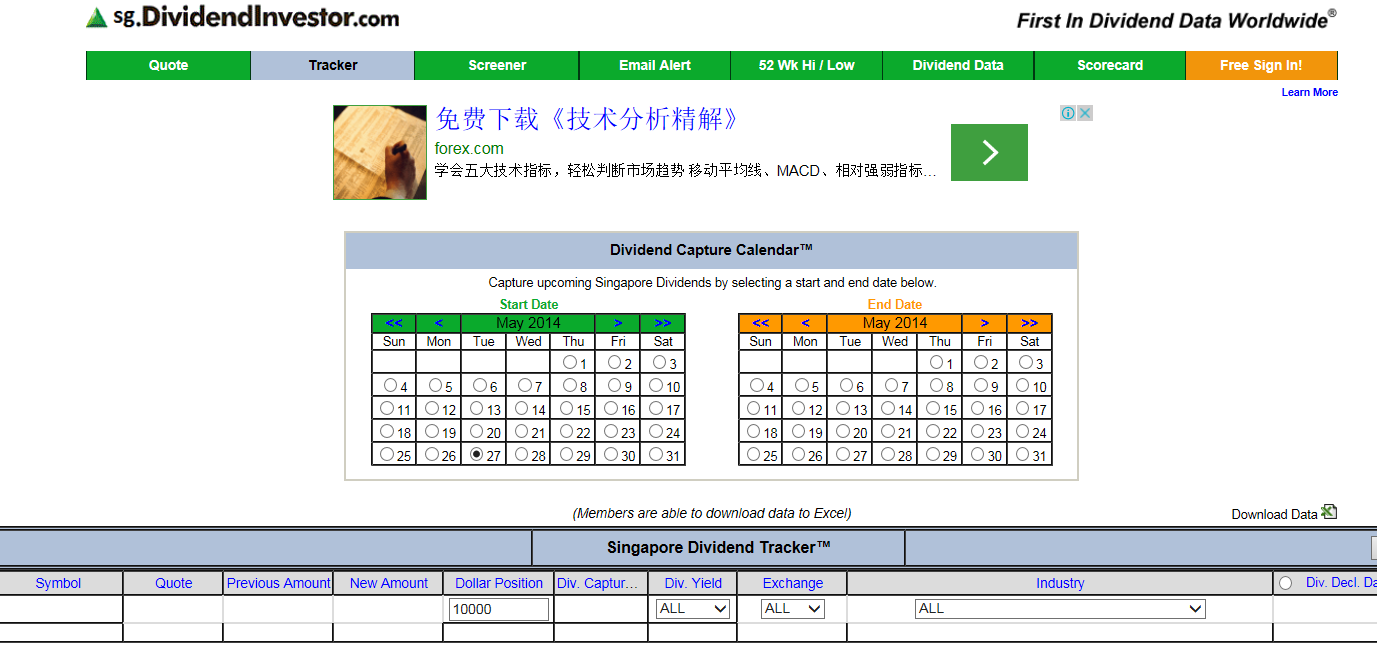
    This is probably more relevant to those dividend investors, with their build-in screener (or tracker), you can filter those upcoming stocks with dividend by date range. This is the only dividend stock screener that I chanced upon with dual language (English/Chinese) setting. NOTE : you need to register and sign-in before screening or else the Stock symbols will not be reflected.

    Click here or the image below to access the tool.  
    http://sg.dividendinvestor.com/tracker.php

    Hope that you folks find the above sharing useful and I am sure that there are other more powerful FREE stock screeners out there. Do share with us if you chanced upon one or two out there

    Read more at http://investopenly.blogspot.com/2014/05/four-free-stock-screeners-that-do-wonder.html#4ybBPP316glhGEPX.99

    Friday, May 23, 2014

    All about CPF minimum sum and CPF life (explained in Layman)

    This blog really explained the CPF's minimum sum and CPF Life even a child will understand...

    Is increase in minimum sum a bad thing?
    There has been much discussions on the CPF minimum sum recently again. The CPF minimum sum will be raised to $155,000 from July 2014. This amount has been raised consecutively for at least the past 10 years. From $80,000 in 2003 to $155,000 in 2014. Of course, people will naturally be unhappy since they realised that the amount they can take out from their CPF becomes lesser and lesser. If you do not meet the minimum sum, you can only take out a maximum of $5000 from your CPF. I'm only in my 20s now and by the time i'm 55, the minimum sum will be much higher. Some people might ask will we be able to take out our CPF money at all?

    I've done some research on the whole CPF structure and now i understand where the government is coming from. My parents have reached 55 and they are still confused about how the whole system works. There is just too much noise and confusion out there. That is why i decided to embark on my own research to find out more. The CPF scheme may not be that bad an impression as what was painted outside and in social media. I'll explain this in a simple and direct way. I'll only touch on what most people are concerned on.

    What is CPF for?
    This is a simple question with a simple answer. The CPF is for our retirement. We have to understand that this is our own money and the government is in no way trying to keep or take our money. When a person reaches 55 years old, a retirement account will be opened. Let's take a look at 2 different scenarios:

    When you reach 55 years old
    1) A person who does not meet the minimum sum of $155,000
    If a person only has $100,000 in his Ordinary account (O.A) and Special account (S.A) combined, he can only withdraw a maximum of $5000 at age 55 and the rest will be put into his/her retirement account(R.A) in CPF. This works out to be $95,000 in his/her R.A.

    2) A person who meets the minimum sum of $155,000
    If a person has $200,000 in his OA and SA account combined, he can withdraw all of the money less the minimum sum. He/she can withdraw $45,000 at age 55. Therefore, $155,000 will be put into the RA account.

    However, there is also a medisave minimum sum(MMS) which we need to meet. The MMS will be $43,500 from 1 July 2014. If you do not have this amount in your Medisave, you'll need to top it up with your OA and SA to make up for the shortfall before you can withdraw the balance after meeting the minimum sum.

    3) A person who meets or does not meet the minimum sum of $155,000 and pledges his/her house
    You can pledge your house value up to half of the minimum sum. This means for a minimum sum of $155,000, you can pledge up to $77,500. By pledging your house, you can actually draw out more money, which means you can take out an extra of $77,500 out in cash from your CPF once you reach 55. However, because you draw out more money at age 55, your RA account will have lesser money and you will receive lesser monthly payout at your draw-down age. For those born after 1953, the draw down age is 65.

    For example, if you have $200,000 in your OA and SA currently, you can withdraw $122,500 out from your CPF at age 55 if you pledge your house. This is more than the $45,000 previously for a person who does not pledge his/her house. If you have less than the minimum sum in your OA and SA combined, your house will be automatically pledged up to 50% of the minimum sum to make up for the short fall. For example, if you have $100,000 in your OA and SA, your house will be automatically pledged.

    However, do take note that you can only pledge up to the amount you pay for your housing loan using CPF. If you used only $50,000 in your CPF to pay for your house, then you can only pledge up to $50,000.

    *Note: If you pledge your house and then decide to sell your house after that, you'll have to return back the pledged amount plus interest back to your CPF account. 

    Sources: http://mycpf.cpf.gov.sg/Members/Gen-Info/FAQ/MinimumSum.htm

    What is the retirement account used for?
    The RA account is used to pay for your retirement needs. Depending on how much you have in your RA account, you'll receive a monthly sum of money at your draw-down age. As mentioned earlier, the draw-down age for those born after 1953 is age 65.

    The money in your RA account can be put into a scheme called the CPF life. You will be automatically placed on the CPF life scheme if you're born in 1958 and after. For those born before 1958, you have a choice to join CPF life or remain on the minimum sum scheme.

    So what is the CPF life? As quoted from the CPF life FAQ page: "The CPF Lifelong Income For the Elderly (CPF LIFE) Scheme provides you with a monthly payout starting from your drawdown age (DDA), for as long as you live. It improves on the Minimum Sum (MS) Scheme, where payouts only last for about 20 years."

    CPF life scheme
    Meets minimum sum and on CPF life scheme
    CPF life pays you a monthly sum of money for as long as you live. You do not have to worry about depleting your RA account on the minimum sum scheme which only pays up to 20 years. With this, a person who meets the minimum sum of $155,000 and is put into the CPF life scheme will receive a monthly payout estimated to be around $1100-$1200 at draw-down age. This monthly payout is not fixed and will be adjusted from time to time. I'm not sure how they calculate the payout though. You can use a CPF Life payout calculator to estimate the monthly payout you will receive.

    Do not meet minimum sum
    If a person does not meet the minimum sum, he/she will still be automatically placed on the CPF life scheme if:

    1) He/she is born in 1958 or after and
    2) Has $40,000 in RA at age 55 or
    3) Has $60,000 in RA at draw down age

    If a person is born before 1958, he/she can choose to stay on the minimum sum scheme which is to draw down his/her RA funds for 20 years or choose to join in the CPF life scheme to receive monthly payout up till death. Point 2 and 3 above applies as well.

    Sources: http://mycpf.cpf.gov.sg/Members/CPFSchemes/CPF_LIFE.htm

    The more money you have in your RA, the better the payout 
    The minimum sum was raised to ensure better payout for Singaporeans when you're old. Imagine if the minimum sum is still at $80,000 in 2003 and has not raised till now, what would be the monthly payout you will receive? Using a CPF Life payout calculator, the monthly payout is estimated to be $695 to $766. Is this enough to survive on?

    Of course, we can argue that why not the government give us all our CPF money at age 55 and not have all these CPF life scheme or this minimum sum thing? It's our money after all and we can decide how we want to spend it right? Don't the government trust us to manage our own money? The truth is, very few people will be able to manage their money wisely. Either we spend it lavishly to enjoy or we get cheated of our money at old age. This has happened a lot of times. Some gamble it away while some fall into scams. This is the reality. With this, the CPF schemes act as a safety net to prevent escalating social problems.

    So, with the minimum sum raised to $155,000 from 1 July 2014, the estimated payout is about $1200 monthly. This is a decent sum to live on during retirement and we do not have to worry about having not enough money at all if we're under CPF life scheme. It's like an allowance you will get for the rest of your life. Sounds like back to school days when your parents gave you an allowance?

    What happens if you die early?
    When we talk about retirement, we have to bring in the topic of death. If you die before you can receive the monthly payouts, then the total amount in your RA + interest + the unused annuity premium paid on CPF life, will be paid to your beneficiary whom you nominate under the CPF nomination scheme.

    If you die after receiving your monthly payouts say age 75, then the total amount in your RA + interest + unused annuity premiums paid - annuity payouts, will be paid to your beneficiary. You can use the CPF life payout calculator to gauge roughly how much your bequest will receive at different stages of your life.

    Sources: http://mycpf.cpf.gov.sg/Members/CPFSchemes/CPF_LIFE.htm

    Conclusion
    I hope by writing the above information, you can have a better understanding of how the CPF schemes work. CPF is for your retirement. People may not like it since it feels like our money is locked up in it. It is in actual fact a forced savings scheme which delays our gratification. Even when you save money yourself, it's the same feeling. But how many people are disciplined to force themselves to save? Most probably when we see the latest gadget, the great Singapore sale or the travel sales, we'll unknowingly spend it all away.

    Of course as with every other schemes, there will surely be weaknesses in it. Some argue that the interest paid on the CPF OA account at 2.5% is too low. Yes i agree its low and not enough to fight inflation but then again for those who have no investment knowledge, getting 2.5% anywhere is virtually non existence now. Remember the banks only pay 0.05% on your savings account currently. We can only hope that the interest rates in CPF will rise in the future. CPF OA interest rates did rise to above 4% during the late 1990s. 

    More continuation about pledging of your HDB

    Sunday, May 18, 2014

    19 Things Unhappy People Do

    Everyone has their off days, but why cause more negativity you can avoid it?
    If you work on thinking positively about yourself and others, you will be that much closer to being your happiest self.
    Below are 19 things unhappy people do that we should all try to avoid.

    1. They worry about things they can't change

    We are all guilty sometimes of wondering what might have been if we had chosen or acted differently. But in most cases, this is a dead-end street. Unhappy people tend to brood about the "could've, should've, would'ves" of life, but it's important not to worry about things we can't change; instead, we should learn from our mistakes and simply try to do better next time! We may even end up being happy that we made some mistakes.

    2. They give up when things get too hard

    Unhappy people tend to back down when they are presented with a challenge. It's easy to throw in the towel when things seem like a lost cause, but powering through and persevering will usually yield good results. Giving up just leaves you feeling defeated. Regardless of the outcome, following through boosts confidence and reassures us that when all is said and done, we did everything we could to make it happen!

    3. They take themselves too seriously

    People who take themselves too seriously tend to take life too seriously in general. If you are able to take a step back and laugh at yourself and the absurdity of life every now and then, things won't seem so dire.

    4. They never exercise

    Exercise has countless mental and physical benefits. The more you exercise, the better you feel about yourself and the more likely you are to live a healthy lifestyle. Ditching exercise for a more sedentary way of life can have an overall negative effect on mood, health, and happiness. Here are some workouts that match different moods!

    5. They set unattainable goals for themselves

    We all know that setting goals for ourselves is important; it's the only way to get things done! But it can be a problem when the goals are unrealistic and unreachable. While we think it's great to always reach for the stars, people who hold themselves to impossible standards will be left feeling disappointed if they don't succeed. The key is to set small and attainable goals for yourself, and you will feel great when you meet and even exceed them. Remember — nobody is perfect!

    6. They eat unhealthy foods often

    Everyone has their guilty food pleasure (truffle fries, anyone?), and we fully support the occasional indulgence. However, unhappy people tend to let their indulgences become their habits. Eating healthy foods can lift your mood, give you more energy, and improve your physical health. Plus, there are so many great healthy recipes out there to try!

    7. They don't get enough sleep

    Sleep is essential! The amount of sleep you get corresponds with how happy and productive you are the next day. You may think that putting in that extra hour of work is a good idea, but nine times of out 10, work — and most other things! — should take the backseat to a good night's sleep. Check out some good bedtime habits to aid your beauty sleep!

    8. They focus on their weaknesses, not their strengths

    We all have our insecurities — the key is to embrace the good and try not to focus on the bad. Self-improvement is important, but unhappy people tend to dwell too much on their weaknesses instead of working on having a positive self-image. We should recognize our flaws and own them but never let them hold us back!

    9. They spend too much time on social media

    This one is a biggie! These days people lay out their whole lives online, and there are many drawbacks to this kind of social media over-share. For one, we can spend too much time comparing ourselves to other people. It's great that your friend just got a new job, got married, or had a baby, but it's OK that you are at a different — and just as important! — part of your life. It's a good idea to take a step away from the screen and get some perspective. Unhappy people tend to get caught up in social media and worry too much about how they appear to other people, which can have a negative effect on how they view themselves.

    10. They stay in their comfort zones

    It's easy to stay in our comfort zones where we feel safe and where the potential for risk is low. But staying there too long means we may be missing out on some great things in life. A huge contributing factor to unhappiness is boredom — and this can be easily remedied by trying new things and taking some risks! We don't necessarily mean that you should drop everything and go skydiving, but maybe try a new type of food, go see a show that sounds unusual, or take a weekend trip somewhere that you've never been.

    11. They worry about what other people think

    Unhappy people tend to care too much what people think. At the end of the day, there is only so much you can do to please other people, so what matters most is loving yourself!

    12. They gossip or speak negatively about others

    Our moms taught us many things — one important lesson being that if you can't say something nice, then there is no reason to say anything at all. People who are unhappy sometimes try to bring other people down in order to make themselves better, but this never works! A better remedy is to lift others up and work on feeling great!

    13. They work too much

    Everyone deserves a mental health day! People who work too much can often neglect their needs, and sometimes all you need is a day to take a break from work and focus on yourself!

    14. They isolate themselves

    When things get tough, it's easy to withdraw from the people who care about you. But spending time with close friends and family when you're unhappy is actually a great way to feel better! Sometimes being with people can take our minds off whatever is bringing us down, so surrounding ourselves with people who love us most is a great way to turn things around.

    15. They never indulge themselves

    Happy people know that it's important to take a vacation, splurge on a new outfit, or enjoy a spa day now and then. People who aren't happy sometimes forget that taking care of themselves is just as important as taking care of others. Make sure to treat yourself!

    16. They're OK with settling

    People who are unhappy often stay in their comfort zones and are content to settle for things. Whether it's staying stuck in a relationship that isn't making us happy or settling for one job when we have our eye on another one, staying in ruts can make us feel like our lives have plateaued. Happy people work to get themselves out of these ruts and make the changes needed to start heading in the direction they want to be going!

    17. They refuse to forgive

    Unhappy people tend to hold on to grudges, but there is freedom and peace in letting go of things and offering forgiveness to yourself and others.

    18. They avoid planning and organization

    Disorganization can leave people feeling like their lives are in a state of disarray. Even if it is something as simple as rearranging your room or trying out these DIY organization hacks, restoring order can help you feel like you have regained a measure of control over things. Unhappy people who avoid organization and planning ahead tend to be less prepared to deal with life's twists and turns.

    19. They focus only on themselves

    While caring for yourself is essential, unhappy people tend to only think of themselves. Treating others unkindly or constantly focusing on yourself and your own problems can be harmful to your well-being and happiness. It's amazing what a little bit of kindness and looking at the bigger picture can do for the soul!

    What happens to your food as it travels through your body until it exits.

    SO COOL! Get rid of mosquitoes Easy way LOVE this!

    Words can be Weapons

    BE CONSCIOUS... Whatever you say or do (to your kids) have consequences.


    Saturday, April 19, 2014

    An Ex-CPF Employee Exposes the 3 Biggest Complaints Singaporeans Have About Their CPF Accounts

    Few questions divide Singaporeans as much as this one – What is CPF used for? As you process your own answer to that question, chances are the words “retirement,” “housing,” healthcare” and maybe “Ponzi scheme” are running through your head.
    But no matter what function(s) you think CPF serves, everyone faces the reality of having to pay their “dues” to keep the system going. That means contributing 20% of your salary (up to age 50) every month to a scheme that only benefits those who vastly surpass the current minimum balance of $148K. Sadly, more Singaporeans who have money in CPF and need it can’t even touch it.
    An ex-CPF employee named “Brian” (who wishes to remain anonymous for very obvious reasons), who deals with the valid concerns of Singaporeans daily, was kind enough to help us shed some light on what Singaporeans complain about most when it comes to their CPF accounts.
    Here are Singaporeans’ 3 biggest complaints about their CPF accounts:

    1. It’s Nearly Impossible to Access Your Retirement Account (RA) Funds 
    The biggest limiting factor people have when it comes to their CPF accounts is the fact that their Retirement Account (RA) funds are about as inaccessible as Area 51 until you reach the draw down, which varies from 62 to 65 depending on your year of birth.
    The problem with having an inaccessible RA account is that it leaves Singaporeans still servicing their home loan with their CPF in a helpless situation because:
    1. Retrenchment: No income means they can no longer make contributions into their Ordinary Accounts (OA).
    2. Contribution level: The contribution level decreases significantly after 55, making it harder to meet the minimum cash component in RA.
    “It’s sad, there were several occasions when we had to direct Singaporeans to HDB or the banks because our hands were tied – we couldn’t release their funds to them even though they may have thousands in their RA to help with their home loan repayments,” says Brian.


    Ironically, the only exceptions for using your RA funds involve purchasing property under the following conditions:
    1. You can only use the excess in your RA AFTER setting aside the minimum cash component, which is currently $148K.
    2. Of that $148K, you’ll need to maintain $74K in your RA, with the excess (excluding annual interests) being available for the purchase of property.
    *Note on property purchases: According to Brian, there is a way for you to use your OA towards purchasing property. If you have booked a BTO flat before turning 55, you can write in to CPF to have funds from your OA reserved for the purchase. In fact, Singaporeans have been successful in having these requests approved.

    2. You Can’t Withdraw As Much from CPF at Age 55 

    Just a few years ago, if you turned 55 before 2009, you could have withdrawn 50% of your combined OA and Special Account (SA) funds! So if you had today’s current minimum sum of $148K, you could withdraw $74,000.

    Then in 2009, the limit dropped to 40%. And then… well, I think you know where this is going right? Let’s just say that CPF reduced the withdrawal limit faster than an Indonesian palm plantation owner reduces forestland.
    Today, if you don’t have the full minimum sum of $148K – you ONLY get $5K. The rest gets sent over to your RA, which you probably won’t see for another 7 to 10 years.
    The biggest complaints Brian received about the inability of some Singaporeans to get more than $5K were:
    • Couldn’t pay off debts: Singaporeans who were financially troubled and had debts to pay off could not pay them even though they had thousands of dollars in their RA.
    • In danger of home repossession: Singaporeans who were having trouble keeping up with their home loan repayments due to retrenchment or financial difficulty couldn’t access the money they needed to maintain their repayments even though they might have had $50K in their RA.
    • Couldn’t go on pilgrimage: Many elderly Muslims who were waiting till age 55 to use their funds to go on pilgrimage (Hajj) were left disappointed when the amount they could withdraw wasn’t enough.
    *Note on pledging your property: Brian points out that if you’ve used your CPF to purchase a home, you can opt to pledge or increase the pledge of your property. So if you just turn 55 this year and you’ve got the full minimum sum of $148K, you can pledge your property up to $74K, freeing up the “excess” $74K in your CPF for withdrawal.

    3. There Are Times When You CAN’T Use CPF for Housing 
    When you buy a home, there’s a limit to how much CPF you can use to purchase a home, called the Valuation Limit (VL). The VL is determined by the lower value of either the market price or the valuation price of a home, and you cannot withdraw more than 120% of the VL, which is called the Withdrawal Limit (WL).
    So what happens when you reach the VL of your home?
    If you’re below 55, you’ll need to maintain either half the prevailing minimum sum cash component (Your OA+SA+SA investments) or the minimum sum cash component in your RA if you’re over 55 (and you can only use your RA excess to service your home loan). If you don’t follow these conditions, you CAN’T use your CPF to service your home loan.
    Not knowing when you can’t use your CPF to service your home loan is a huge reason why people contact CPF, especially when Singaporeans:
    • Reach their VL before age 55 and haven’t maintained half of their prevailing minimum sum cash component (OA+SA+SA investments).
    • Reach their VL after age 55 and haven’t maintained their minimum sum cash component in their RA (only RA excess can be used!).
    • Surpass their WL.
    CPF Staff Are There to Help, But They Don’t Make Policy 
    We understand that CPF needs to be more flexible in allowing Singaporeans to use their funds. What’s the point of having thousands of ‘untouchable’ dollars set aside for retirement when Singaporeans are dealing with financial difficulty now? But we do our best to help people out as much as possible,” says Brian.

    Brian also stated that the complaints above made up about 70% of their total communications. That’s A LOT of daily gripes to deal with.

    Most Singaporeans have their reasons to complain about CPF. If you’ve read Dear CPF: Give Me Back My Money, you know just a few of the many grievances people have with the scheme. But before you call up or email CPF to give them a piece of your mind, please remember that the hard working employees don’t set policy – they’re there to help you as best as they can.

    Sunday, March 30, 2014

    Chinese Billionaire Jack Ma: The “Dos and Don’ts”of Being an Entrepreneur

    If you don’t know who Jack Ma is, you should. Regarded as one of the first Chinese internet entrepreneurs, Jack Ma started in 1995 with China Yellowpages before founding what is now Alibaba Group, a highly successful internet-based holding company that earned Ma a spot on the world’s billionaires list. Most recently, Ma was the first mainland Chinese entrepreneur to ever appear on the cover of Forbes in 2011 and was named the Financial Times’ 2013 Person of the Year where he was referred to as the “godfather of China’s scrappy entrepreneurial spirit.”

    In a post that was originally published and translated from Chinese, Jack Ma shared some business and life wisdom that we could all learn from including the biggest issues younger generations have to face in business and the “dos and don’ts” of entrepreneurship. We can all learn a thing or two from a successful billionaire entrepreneur.

    Jack Ma talks about the mistake he regrets the most.
    “In 2001, I made a mistake. I told 18 of my fellow comrades whom embarked on the entrepreneurship journey with me that the highest positions they could go was a managerial role. To fill all our Vice President and Senior Executive positions, we would have to hire from external parties. Years later, those I hired were gone, but those whom I doubted their abilities became Vice Presidents or Directors. I believe in two principles: Your attitude is more important than your capabilities. Similarly, your decision is more important than your capabilities!”

    Jack Ma on how to bring your company’s employees together.

    “You cannot unify everyone’s thoughts, but you can unify everyone through a common goal.

    1. Don’t even trust that you are able to unify what everyone is thinking; it is impossible.

    2. 30% of all people will never believe you. Do not allow your colleagues and employees to work for you. Instead, let them work for a common goal.

    3. It is a lot easier to unite the company under a common goal rather than uniting the company around a particular person.”

    Jack Ma’s answer for “What does a leader have that an employee doesn’t?”

    “A leader should never compare his technical skills with his employee’s. Your employee should have superior technical skills than you. If he doesn’t, it means you have hired the wrong person. What, then, makes the leader stands out?

    1. A leader should be a visionary and have more foresight than an employee.

    2. A leader should have higher grit and tenacity, and be able to endure what the employees can’t.

    3. A leader should have higher endurance and ability to accept and embrace failure.

    The quality of a good leader therefore is his vision, tenacity, and his capability.”

    Jack Ma on why you should never mix politics with business.

    “Don’t be involved in politics.

    1. One should always understand that money and political power can never go hand in hand. Once you are in politics, don’t ever think about money anymore. Once you are running a business, don’t ever think of being involved in politics.

    2. When money meets political power, it is similar to a match meeting an explosive- waiting to go off.”

    Jack Ma on the four main questions the younger generations have to ask themselves.

    “What is failure? Giving up is the greatest failure.

    1. What is resilience: Once you have been through hardships, grievances and disappointments, only then will you understand what is resilience.

    2.What your duties are: To be more diligent, hardworking, and ambitious than others.

    3. Only fools use their mouth to speak. A smart man uses his brain, and a wise man uses his heart.”

    Jack Ma: “We are born to live and experience life.”

    “I always tell myself that we are born here not to work, but to enjoy life. We are here to make things better for one another, and not to work. If you are spending your whole life working, you will certainly regret it.

    No matter how successful you are in your career, you must always remember that we are here to live. If you keep yourself busy working, you will surely regret it.”

    Jack Ma on competing and competition.

    “1. Those that compete aggressively with one another are the foolish ones.

    2. If you view everyone as your enemies, everyone around you will be your enemies.

    3. When you are competing with one another, don’t bring hatred along. Hatred will take you down.

    4. Competition is similar to playing a board of chess. If you lose, we can always have another round. Both players should never fight.

    5. A real businessman or entrepreneur has no enemies. Once he understand this, the sky’s the limit.”

    Jack Ma: “Don’t make complaining and whining a habit.”

    “If you complain or whine once in a while, it is not a big deal. However, if it becomes habitual, it will be similar to drinking: the more you drink, the stronger the thirst. On the path to success, you will notice that the successful ones are not whiners, nor do they complain often.

    The world will not remember what you say, but it will certainly not forget what you have done.”

    Jack Ma’s seven points of wisdom for entrepreneurs.

    The opportunities that everyone cannot see are the real opportunities.
    Always let your employees come to work with a smile.
    Customers should be number 1, Employees number 2, and then only your Shareholders come at number 3.
    Adopt and change before any major trends or changes.
    Forget the money; Forget about earning money.
    Rather than having small smart tricks to get by, focus on holding on and persevering.
    Your attitude determines your altitude.
    Jack Ma on advice you should remember for life.

    “1. A great opportunity is often hard to be explained clearly; things that can be explained clearly are often not the best opportunities.

    2.You should find someone who has complementary skills to start a company with. You shouldn’t necessarily look for someone successful. Find the right people, not the best people.

    3. The most unreliable thing in this world is human relationships.

    4. “Free” is the most expensive word.

    5. Today is cruel, tomorrow will be worse, but the day after tomorrow will be beautiful.”

    Jack Ma on the three “don’ts” of entrepreneurship.

    “1. The scariest things about starting up is the inability to see, to be snobbish, to be unable to understand what is going on, as well as to be unable to keep up with pace.

    2. If you do not know where your competitor is, or overconfident and snobbish about your competitor, or are unable to comprehend how your competitor became a real threat, you will surely fall behind him. Don’t be the “they” in this idiom: First they ignore you, then they laugh at you, then they fight you, then you win.

    3. Even if your competitor is still small in size or weak, you should take him seriously and treat him as a giant. Likewise, even if your competitor is massive in size, you shouldn’t regard yourself as a weakling.”

    Jack Ma on starting your own company.

    “What starting your company means: you will lose your stable income, your right to apply for a leave of absence, and your right to get a bonus.

    However, it also means your income will no longer be limited, you will use your time more effectively, and you will no longer need to beg for favours from people anymore.

    If you have a different mindset, you will have a different outcome: if you make different choices from your peers, your life will then be different from your peers.”

    Jack Ma on when you should take opportunities.

    “If there are over 90% of the crowd saying “Yes” to approving a proposal, I will surely dispose the proposal into the bin. The reason is simple: if there are so many people who thinks that the proposal is good, surely there will be many people who would have been working on it, and the opportunity no longer belongs to us.”

    Wednesday, March 12, 2014

    Good advice from AK71

    ASSI is a blog I follow faithfully. The owner is a unselfish, genuine, knowledgable guy who
    shared his opinion on Insurance, Investing (mainly), etc Below is an extract from his blog
    which I think should shared out more...

    Graduating soon? Take steps towards financial security.
    Wednesday, March 12, 2014
    Received an email from a reader who is about to graduate and join the workforce:

    Hi AK,
    I am C and this is actually my first time writing to a blogger.
    I've recently found your blog and you've been such an inspiration to me and my "future
    financial life".

    Would like to sincerely thank you for setting up this blog to benefit us youngsters in
    Singapore. :)

    I am about to graduate soon in a couple of months and I'm just wondering if you can provide
    some advice to me...

    Upon graduation and receiving my first pay check, would you recommend me to first set up my
    emergency fund or invest in FDs or buy insurance or voluntarily top up my CPF or invest in
    a SRS account or a combination of some?
    There just seem to be many things I should do but I'm not sure which one I should focus on to
    get my priority right. Thank you for your kind advice, AK.

    Warmest regards
    C

    My reply:

    Hi C,
    I am not allowed to give advice but I am happy to share with you what I would do if I were in your shoes. :)

    1. Buy a term policy. Very important if we have parents or other dependents to care for. 
        How much should the coverage be? It is up to you but I feel that $500K is probably 
        more than adequate for most.

    2. Buy a good H&S policy. Personally, I have NTUC Incomeshield with Assist Rider. 
        We don't want to be sunk by hospital bills. How much you would spend here depends 
        on whether you are comfortable with Class C, B or A wards or if you want to stay in private  
        hospitals.


    3. Buy a Critical Illness policy. We need this money to help pay for long term treatments if 
        we should be diagnosed with one of these illnesses and not die. I am covered for $300K 
        but, for a start, I think $100K should be comfortable.

    4. Set up an emergency fund. Slowly build this up so that it is enough to cover at least 
        12 months of regular expenses (including insurance expenses). My preference is for 
        24 months. In case we lose our jobs or are unable to work for some reason, this is the 
        fund we would draw upon.

    Once we have done all these, we can start thinking about investing for a second stream of income.
    Of course, if we can pay less taxes, we should. In planning for retirement, you want to consider topping up your CPF-SA to a maximum of $7K a year. Of course, you could also start an SRS account.

    The tools are out there to help us achieve financial security. You will do quite well if you make good use of them. :)

    Best wishes,
    AK

    Stop Pushing Water Down - Push It Back for Real

    Good video on our arm movement by @oceanswimschool